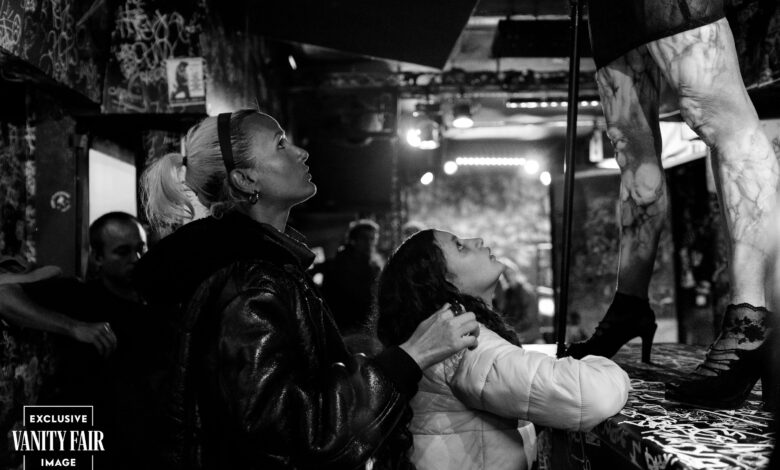
Alpha’s eyes are opened up as she’s ostracized after potentially contracting the virus. This is a story about what it means to emancipate from your mother, a departure from Ducournau’s past focus on fathers and daughters. That’s one of the aspects of the story that scared her the most. “When you’re talking about a father, it’s mainly about losing the idea of being validated in someone’s eyes,” she says. “With mothers, it’s really about tearing away from a symbiotic bond and a fusion—which is way, way harder to do.”
Yet there’s also a kind of wonder in Alpha’s forced development. She engages in her own desires and emotions. She sees people differently. She’s more exposed to the marginalized, including the queer community, who still palpably feel the scars of the AIDS epidemic.
“How can I talk about this without talking about the LGBTQIA community?” Ducournau says. “It’s impossible. It was obvious to me that I needed to talk about the people harmed by the way society treated them.”
While Ducournau fully embraces the messy, at times painful mother-daughter dynamic at the story’s center, the heart and hope of the story is the relationship between Alpha and her uncle, Amin. When Amin first comes to live with her, Alpha is flatly terrified. “He looks the way he looks, and it’s disgusting to her,” Ducournau says. But gradually, Amin emerges as the only truth-teller in her life. Rahim, who reportedly lost dozens of pounds to play the role, portrays him with moving, at times ecstatic vibrancy. Ducournau lights the character like an angel, his cracked statuesque frame managing to find the light in darkness.
“He says the truth very bluntly, like a kid would. He helps her grow up, he helps her cry,” Ducournau says. Even though Alpha and Amin are related, they also become one another’s chosen family. “I like the idea that relationships in family are not granted. You have to tame each other, and you have to grow together to build a bond,” she says. “This is how you become a family. It’s not just by blood.”
Every choice Ducournau made in Alpha was made meticulously and with tremendous feeling. “We still have not grieved these losses,” she says. We’re speaking just days after she finished the film, and she’s nervous about unveiling it to the world. “I’m still in this floating moment, where you haven’t completely abandoned it and you’re not sure you’re ready to show it,” she says. While Alpha may technically be less bloody than Raw and Titane, you sense that Ducournau has put more of her own guts into it. It’s a vulnerable film, one that inches the audience even closer to this artist’s interior life.
Ducournau spent years wondering if she was old or experienced enough to make this movie. Then she wondered if she was brave enough. She doesn’t mind dividing audiences, leaving them uncomfortable, so long as she knows she went as far as she could. “With each film, I’m thinking that I can put myself in a more vulnerable place, in order to relate to the audience more and more,” she says. “And I’m not done digging. It’s an eternal path: How can I be more sincere? How can I get closer to my emotions? How can I show them in a more precise way, with more generosity? To me, that is the only path. That’s why I make films.”
This story is part of Awards Insider’s in-depth Cannes coverage, including first looks and exclusive interviews with some of the event’s biggest names. Stay tuned for more Cannes stories as well as a special full week of Little Gold Men podcast episodes, recorded live from the festival and publishing every day.
Listen to Vanity Fair’s Little Gold Men podcast now.
-
Inside LA’s Young, Testosterone-Fueled Sperm Race
-
The Nuances of Casey Means’s Medical Exit and Antiestablishment Origins
-
Molly Jong-Fast Reflects on Her Mother’s Dementia and the Fleeting Nature of Fame