Department Of Education Publishes New Rules Restricting Student Loan Forgiveness For PSLF

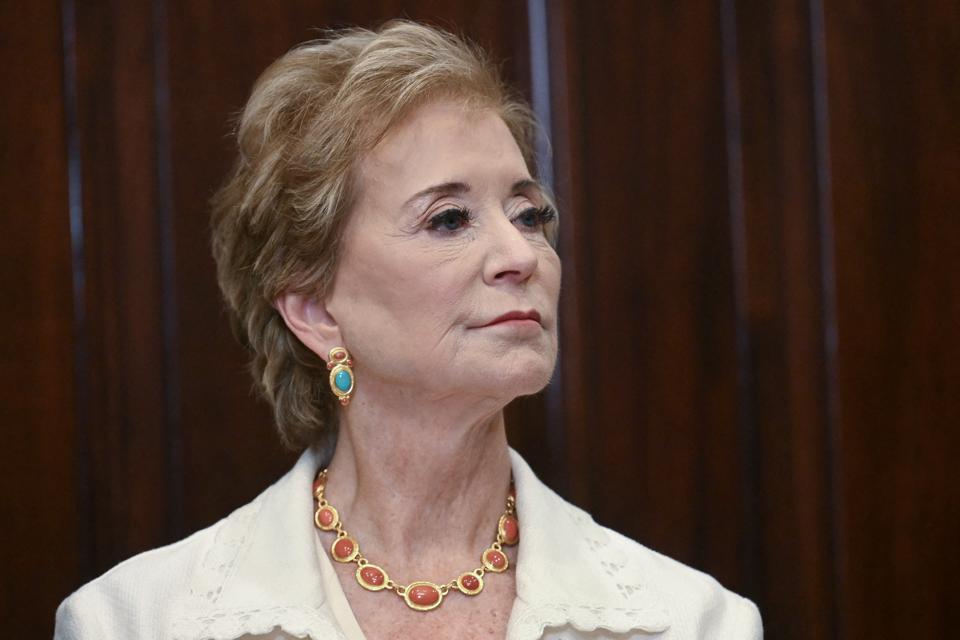
US Secretary of Education Linda McMahon listens after the signing an executive order in the Roosevelt Room of the White House in Washington, DC, on July 31, 2025. Under McMahon, the Department of Education has moved to implement President Trump’s executive order to limit student loan forgiveness under PSLF. (Photo by Jim WATSON / AFP) (Photo by JIM WATSON/AFP via Getty Images)
AFP via Getty Images
The Trump administration on Friday released for public inspection new regulations designed to limit student loan forgiveness under the Public Service Loan Forgiveness program. The publication does not mean the rules are in effect yet. But it does move the process to restrict PSLF one step closer to reality, with major implications for millions of federal student loan borrowers.
PSLF is a popular program, first enacted under President George W. Bush in 2007, to encourage borrowers to take traditionally lower-paying jobs at government and nonprofit organizations. These types of roles typically require advanced degrees (such as law degrees for attorneys working as prosecutors or public defenders, or nursing degrees for nurses working in community health) but often pay much less than comparable private sector jobs. For example, the average starting salary for a prosecuting attorney is around $57,000 per year. But the average starting salary for a first-year associate at a major law firm is more than $200,000.
PSLF offers student loan forgiveness to borrowers who make qualifying payments on their federal student debt while working in eligible public service employment for at least 10 years. PSLF was plagued by problems for years, but more than a million borrowers were approved for loan forgiveness under the program during the Biden-Harris administration following a series of regulatory improvements.
But the Trump administration wants to curtail relief under PSLF. In March, President Donald Trump issued an executive order calling on the Department of Education to draft new regulations restricting student loan forgiveness under the program. After the department completed a series of controversial negotiated rulemaking hearings on the proposed new regulations earlier this year, officials are now set to take the next step in the process by publishing the proposed regulations in the Federal Register on Monday. Here’s what this means for borrowers.
Proposed Regulations Would Restrict Student Loan Forgiveness Under PSLF
The new rules, if ultimately enacted, would cut off nonprofit or government organizations if the Department of Education determines by a preponderance of evidence “that a qualifying employer has engaged on or after July 1, 2026, in activities that have a substantial illegal purpose.” The proposed regulations define “substantial illegal purpose” to include activities such as providing health care services to transgender youth, facilitating the violation of federal immigration laws, violating state laws, or engaging in activity that facilitates illegal discrimination. The latest version of the regulations largely mirror the preliminary draft regulations the department released earlier this year, with some minor tweaks.
“The regulatory changes outlined in this rule are designed to preserve the integrity of the PSLF program by ensuring that only borrowers employed by organizations engaged in lawful public service remain eligible for forgiveness,” said the department in commentary accompanying the publication of the regulations on Friday. “By excluding employers that engage in activities with a substantial illegal purpose, the rule aims to better align PSLF eligibility with the program’s statutory intent—to reward public service. Furthermore, it ensures that the Department is not indirectly subsidizing employers who are engaging in activities that have a substantial illegal purpose.”
The department acknowledged that the proposed changes to PSLF eligibility could have major impacts on federal student loan borrowers. The new rules could force borrowers to seek out new employment if their job no longer qualifies and they want to continue pursuing student loan forgiveness.
“For borrowers, the proposed rule may alter eligibility for PSLF if they are employed by organizations that no longer qualify under the revised criteria,” said the department. “In cases where an employer is deemed to have engaged in activities that breach federal or state law or established public policy, affected borrowers would no longer receive credit toward loan forgiveness for months worked after the effective date of ineligibility. While this may delay or prevent forgiveness for a subset of borrowers, the overall design of the regulations—including advance notice, transparency around determinations, and employer recertification pathways—helps mitigate unexpected harm. These borrowers would retain the ability to pursue PSLF through eligible employment elsewhere, thereby preserving the program’s incentive structure.”
Critics Argue Proposed Student Loan Forgiveness Restrictions For PSLF Are Illegal
Critics have argued that the proposed regulations to restrict student loan forgiveness under PSLF would allow the Department of Education to cut off entire organizations from the program if their mission or policy goals appear to conflict with the Trump administration’s agenda. And under the proposed regulations, individual student loan borrowers would have no recourse or right to appeal a department determination of employer eligibility.
For example, The Institute for College Access and Success (also known as TICAS), a student loan borrower advocacy organization, argued in a blog post in July that the Trump administration could essentially try to weaponize PSLF to cut off state and city governments that, in their view, are not sufficiently cooperating with the federal government in immigration enforcement.
“In May, the Department of Homeland Security released a list of what it called ‘sanctuary jurisdictions’ that it believed were ‘defying federal immigration laws,’” said TICAS. The list includes more than a dozen states, including large states like California and New York, as well as several major cities including Boston, Denver, New York City, and Philadelphia, all led by Democrats.
“Under the PSLF regulation proposed by the Department of Education, all employees of any of those jurisdictions could lose eligibility to get PSLF because the Department could determine that they are ‘aiding and abetting’ what the Department of Education (not the Department of Justice or Department of Homeland Security) feels is a violation of immigration laws,” said TICAS. “Notably, that determination would not be made by a court, but instead by the Secretary of the Department of Education.”
TICAS noted that the administration could similarly target dozens of major academic institutions. Nonprofit hospitals could also be in the administration’s crosshairs, as well, particularly if they provide healthcare services to transgender youth, although the department clarified in the updated version of the proposed regulations that it would not target hospitals in states where the provision of such healthcare services is legal under state law. The department also clarified in the updated regulations that it would not target employers based on the constitutionally protected speech of its employees.
But critics have also argued that the proposed new PSLF rules are simply illegal. Congress enacted a law to create the PSLF program and specifically defined a qualifying employer to be a 501(c)(3) nonprofit organization or domestic government entity. The Department of Education, they argue, has no authority to change Congress’s definition of a qualifying employer for PSLF.
“During three days of discussions with various stakeholders, the Department repeatedly dismissed pushback and questions, and it made clear that it intends to move forward on what is likely an illegal action,” said TICAS in its blog post. “When Congress passed the PSLF law, it said that all government employers and all non-profit employers qualify, without including any exceptions. The Department’s claim that it can limit eligibility for any employer based on its alleged conduct conflicts with the PSLF law and has no statutory basis.”
Many observers expect there to be legal challenges once the new regulations are finalized next year.
What’s Next For PSLF And Student Loan Forgiveness
The Trump administration’s attempt to limit student loan forgiveness under PSLF is not in effect yet.
“Importantly, no changes will take effect right away,” said TICAS in its July blog post. “The next step is for the Department to publish a proposed rule for public comment in the Federal Register.”
With the early release on Friday of the proposed regulations, a 30-day period of public comment is expected to begin on Monday, which is when the rules will be officially published in the Federal Register.
“We invite you to submit comments regarding these proposed regulations,” says the department. “Please clearly identify the specific section or sections of the proposed regulations that each of your comments addresses and arrange your comments in the same order as the proposed regulations. The Department will not accept comments submitted after the comment period closes.”
The student loan forgiveness restrictions for PSLF are expected to become effective by next summer. “Any member of the public can make a comment about the effect of that rule during the period permitted by the Department,” said TICAS. “After it reviews the comments, the Department will likely release a final rule by November 1, 2025 that would take effect on July 1, 2026.”