Olympic Games Triathlon: Gwen Jorgensen breaks down what went wrong after missing out on USA team for Paris 2024

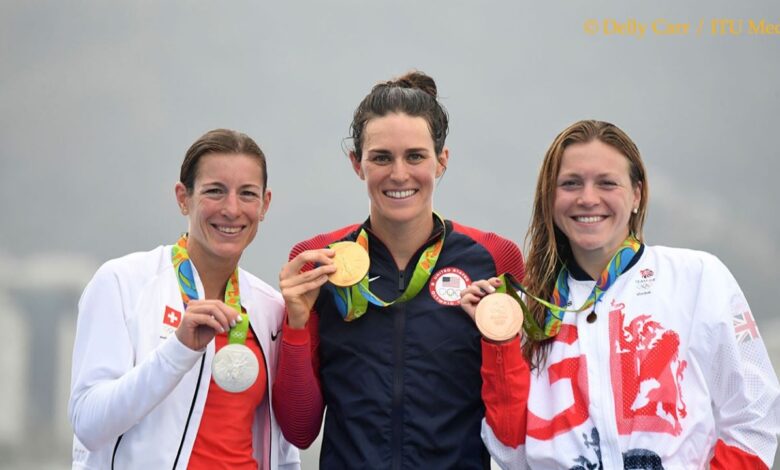
After missing out on the Olympic Games triathlon at Paris 2024, Gwen Jorgensen has shared her thoughts on the selection process.
The 2016 Olympic Champion, who was named as an alternate alongside Tokyo silver and bronze medalist Katie Zaferes, made a return to the sport in the beginning of 2023.
After numerous setbacks, Jorgensen managed to get herself on the start list for the crucial qualifying race at WTCS Yokohama, but finished off the podium in 15th.
Jorgensen on USA selection process
Breaking down the Team USA policy in the latest video on her YouTube channel (watch it in full below here), Jorgensen explained the process she went through in the build-up to the discretionary selection meeting, where Taylor Spivey and Kirsten Kasper were chosen.
“I did not get selected for the Olympics. I am an alternate, as is Katie Zaferes, so there are two alternates. According to the policy, they [USAT] couldn’t look past two years, so they looked at 2023 and 2024 results.
“They couldn’t go back to 2021 or anything like that and the document said that if it’s going to be based on discretion, they need to pick someone who has a chance of winning a medal.”
Put on a list with several other candidates, Jorgensen revealed that she was asked to justify why she should be selected ahead of her fellow countrywomen.
“They reached out to everyone on the list, I think there were five or six on the list and they asked us two questions, why are you the most likely candidate to be able to win a medal in the individual and why are you the most likely candidate to win a medal in the relay?
“When I filled that out, I felt very confident and thought I had a very strong case. But I’m sure everyone who filled out that document also felt the same way.”


ELEVATING ENDURANCE WITH PREMIUM GEAR & SERVICES
The big shock in Paris bid
Sharing the reason she was given for not being selected, the 38-year-old explained that the selectors believed other athletes had shown more consistency.
“I was told the other athletes showed consistency and consistency shows medal potential. The people who were selected were Taylor Spivey and Kirsten Kasper and I think they did a phenomenal job showing up in Yokohama. They were fourth and fifth and I think that was one of the best performances they had.”
Having only returned to the sport last year following a near seven-year hiatus, Jorgensen found it hard to get on the start lists for the biggest races, something she admits now was a problem she had underestimated.
“My whole goal was to make it to the Olympics and when I started this journey in 2023 I think I was naive about how hard it would be to get into races.
“I couldn’t get into WTCS races and even this Olympic cycle, if you look at Kirsten, she had nine opportunities at the WTCS level to prove herself and I had two where I had more than a week’s notice, so I definitely underestimated the opportunities I would have to qualify.
“When 2024 started, I was super-excited, because we were going to get to go to Abu Dhabi, Yokohama and Cagliari. Two of those opportunities were taken away from me and so that was something that put a big hurdle in front of me.
“I think Abu Dhabi being cancelled and USAT taking Cagliari away from me after I was in the Top 5 were two huge obstacles I had to overcome and I wasn’t able to do that.”
Cagliari KO still stings for Gwen
That Cagliari substitution, where the national federation opted to give Jorgensen’s spot to Zaferes, still stings Jorgensen to this day, and was a move which she says really surprised her.

“The hardest part of this year was when I was taken out of Cagliari. It took me completely by surprise, I felt like I had earned my spot there and I just got an email after I had been on the start list for a week that they were taking me off and putting someone else in.
“I was just devastated and I’m probably still not over that. In terms of the Olympics, I knew what the selection was, I knew what the process was and I fully expected once I was taken out of Cagliari that if they’re going to take me out of races, there’s no chance they’re going to put me into races and I always said from day one on this journey that if I didn’t auto-qualify I wouldn’t get selected.
“I filled out the document having convinced myself that I was the only logical choice to be picked, but I also knew based on history that they would never pick me and when I got that news, it wasn’t total devastation like it was in Cagliari.”
“It was a big reason why I quit triathlon”
The internal politics within federations is something Jorgensen is accustomed to, and was a factor in her decision to leave the sport after winning gold in Rio back in 2016.

“My return to triathlon has been enjoyable because I’ve really focused on my why, which is not just about winning but what motivates me and who do I want to embody as a person.
“Back in my previous campaign in 2016, a lot of people don’t know some of the politics that was very frustrating for me and it was a big reason why I quit triathlon.”
During her return to the sport, Jorgensen said that she has observed the same issues, and has found strength in always speaking up for what she believes in.
“This time around, when I see things that are frustrating or rules not being followed, I am someone who is always going to say something and I think that makes people angry at me for sticking up for what should be done and what I fair.
“I think this time around, there may be those same issues, but I say something when it’s not right and even if it doesn’t make a difference, it feels like I’m making a difference and that makes things more enjoyable.”