Student Loan Forgiveness Payment Counts Halted By Department Of Education, Says Servicer


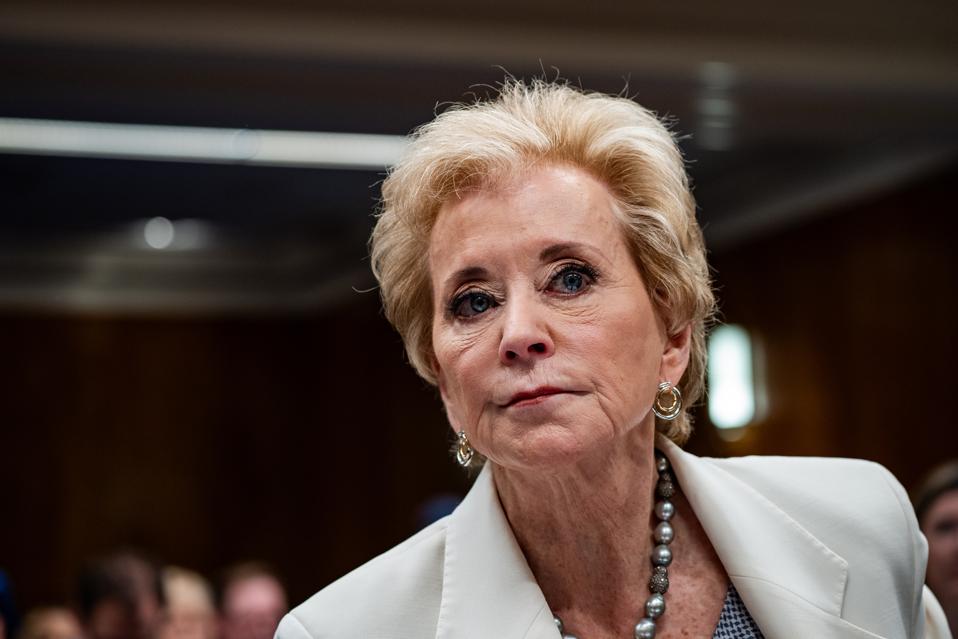
WASHINGTON, DC – JUNE 3, 2025: Linda McMahon, Secretary of Education, during a review of the … More President’s Fiscal Year 2026 Budget Request for Department of Education hearing on Capitol Hill in Washington, D.C., June 3, 2025. McMahon has indicated that the IDR student loan forgiveness tracker will return soon, but so far, that has not happened. (Photo by Salwan Georges/The Washington Post via Getty Images)
A major federal student loan servicer has started notifying borrowers that the Department of Education has temporarily halted payment counts associated with student loan forgiveness progress under IDR and PSLF, and removed the ability for borrowers to monitor their progress. The announcement, which appears to reflect ongoing systemwide problems at the department following mass layoffs last spring, is another setback for borrowers as the federal student loan repayment system remains plagued by dysfunction and backlogs. Meanwhile, Congress and the Trump administration have moved forward to implement massive changes to loan programs that will impact millions of Americans.
“Federal Student Aid has temporarily removed the forgiveness payment counts from StudentAid.gov for Public Service Loan Forgiveness and Income-Driven Repayment,” says an automated announcement on MOHELA’s main customer service phone line for Department of Education accounts. “Unfortunately, our representatives do not have any additional information related to your forgiveness counts. Please continue to visit StudentAid.gov for updates.”
Here’s what we know about MOHELA’s announcement, and what student loan borrowers should understand as the repayment system goes through the most significant changes in a generation.
Student Loan Forgiveness Tracking For IDR Remains Down, Payment Counts Not Updating
In January, during the last month of the Biden administration, the Department of Education launched a long-awaited feature of StudentAid.gov that allowed borrowers to track and review their progress toward student loan forgiveness under income-driven repayment plans. IDR plans provide borrowers with monthly payments tied to a formula based on income and family size, with any remaining balance eligible for loan forgiveness after 20 or 25 years in repayment. Until the IDR tracker went live, borrowers often had no idea where they stood on their progress.
The IDR tracker provided a high-level overview to borrowers of their IDR status. It showed how many months and years they had remaining until they would qualify for student loan forgiveness. And borrowers could access more detailed information showing a monthly breakdown of what was counting toward their IDR term, and what wasn’t.
But last spring, the Trump administration quietly removed the IDR tracker from StudentAid.gov, leaving borrowers in the dark again about their student loan forgiveness progress. The Department of Education indicated that this was necessary to address problems with the tracker and correct inaccuracies. In addition, the removal came after a key court ruling in February that suggested that student loan forgiveness under three IDR plans – ICR, PAYE, and the new SAVE plan – was inconsistent with congressional intent. As a result, the department has blocked student loan forgiveness under these plans.
“Forgiveness as a feature of the SAVE, PAYE, and ICR Plans is currently paused, because those plans were not created by Congress,” said the department in updated guidance issued in April. However, the department noted that student loan forgiveness under the IBR plan remains available. “ED can and will still process loan forgiveness for the IBR Plan, which was separately enacted by Congress. Payments on PAYE, SAVE, and ICR are counted toward IBR Plan forgiveness if the borrower enrolls in IBR.”
In June, U.S. Senator Elizabeth Warren (D-Mass) announced that Education Secretary Linda McMahon had agreed that the IDR tracker would be restored to StudentAid.gov soon.
“Secretary McMahon stated that she intends to soon restore the income-driven repayment (IDR) payment count tracker to Studentaid.gov, allowing borrowers to track their progress towards receiving debt relief, after taking down the tracker earlier in the Trump administration,” Senator Warren said in a June statement.
But so far, Secretary McMahon’s assurances have not materialized. Some borrowers are reporting that IDR counter data still accessible via StudentAid.gov is not updating, while others who should have reached the threshold for student loan forgiveness under IBR have yet to receive a discharge, suggesting that months are not being counted toward borrowers’ IDR repayment terms. If IDR payment counts are not getting updated in the department’s systems, it is unclear how borrowers would receive a discharge.
Student Loan Forgiveness Payment Counts For PSLF Not Getting Updated
Meanwhile, the department does not appear to have removed the student loan forgiveness tracker for the PSLF program, which is good news for borrowers. But PSLF payment counts are not getting updated in the system.
PSLF, or Public Service Loan Forgiveness, allows borrowers to discharge their federal student debt in as little as 10 years. Borrowers must typically repay their loans under an IDR plan while working in qualifying nonprofit or government employment on a full-time basis to receive PSLF credit toward loan forgiveness. PSLF tracking has been accessible via StudentAid.gov since the system was migrated from MOHELA last summer. However, borrowers are reporting that PSLF tracking information has not updated in StudentAid.gov for several months.
“My PSLF counts updated on FSA 4/4,” said one Reddit user. “I’ve submitted a ECF end of April and end of May. I’m super close – depending on how they will count my admin forbearance I’ll be at 120. Nothing is triggering the update despite forms being processed.”
“I recently submitted an ECF (which actually processed quite quickly, so that was nice),” said another Reddit user in May. “I do this a few times a year to keep everything square, and was hoping to add my payment counts since January 2025. I made my payments every month since (Feb, Mar, Apr, May). The problem is FSA only added one month of qualifying payments (February) and nothing appeared for March, April, or May.”
“Welcome to the club,” replied another user.
“Same boat here,” said another “My payment count doesn’t show anything past September 2024, but according to my PSLF dashboard, my account was updated in November. I just submitted my employment verification, hoping it would trigger an update, but no luck – payment count remains at 90 when it should be around 104.”
Student Loan Forgiveness Tracking Issues Worsened By Staff Layoffs
The Department of Education has not issued any public comment or guidance to explain the issues with IBR or with student loan forgiveness payment counts for PSLF. Federal Student Aid customer service agents are, according to some Reddit users, telling borrowers that it can take up to 90 days to update. Other FSA agents are blaming student loan servicers for not reporting payment information to the department’s system, but servicers then appear to be blaming the department.
However, a former Department of Education official who worked in the FSA Ombudsman office, which had handled borrowers disputes, suggested in a court filing last week that the student loan forgiveness payment count issues, particularly for PSLF, are a major known problem, but the department has not addressed it in part because of the mass layoffs and reduction in force implemented under the Trump administration.
“According to FSA employees with whom I consulted, those problems were due to errors in the automation between the National Student Loan Data System and the Salesforce-based system that maintains PSLF employment certification information,” said the official. “Resolving those errors was the responsibility of a special team within FSA. After the mass RIF, the team that previously handled PSLF transfer issues was reassigned to do other work. After the mass RIF, no one was identified who could resolve complaints relating to errors in the PSLF payment count system. This persisted until the date of my separation from federal service.”
“RIF” stands for “Reduction in Force,” the term used for the department’s mass layoffs and buyouts that were first announced in March and cut close to 50% of the department’s staff, including at the Office of Federal Student Aid. The same FSA official appeared to confirm in last week’s declaration that borrowers who qualify for student loan forgiveness under IBR are not receiving a discharge, even though no court has blocked IBR loan forgiveness.
“Additionally, it is my understanding that as of April or early May 2025, federal student loan borrowers who are eligible for income-based repayment cancellation were still not having their loans cancelled—a process that has been paused since July 2024—despite the statutory obligation to do so,” she said.
Student Loan Forgiveness And Repayment System In Turmoil
The issues with student loan forgiveness tracking for IDR and PSLF come as the broader repayment system continues to experience profound turmoil.
Around eight million borrowers who were in the SAVE plan remain stuck in an involuntary forbearance due to court challenges, preventing them from making progress toward loan forgiveness. Many of these borrowers have applied to switch to a different IDR plan. But the Department of Education and its loan servicers are now contending with a 1.5 million IDR application backlog, which loan servicers appear to be addressing steadily, but slowly. MOHELA has suggested that some borrowers should consider reapplying for their IDR plan using the online application system and IRS data retrieval tool.
The department also faces a large and growing backlog for PSLF Buyback, a related program that allows borrowers to make a lump sum payment covering periods of non-qualifying forbearance so that the months can count toward student loan forgiveness. While the department has made some progress in processing a few thousand PSLF Buyback requests, the backlog of applications increased from around 49,000 in May to more than 58,000 in June. Many borrowers have been waiting months for a determination.
Last week, President Trump signed the “Big, Beautiful Bill” passed by Republican lawmakers in Congress. The legislation will make massive changes to federal student loan forgiveness and repayment plans. While PSLF is preserved under the bill, President Trump and GOP lawmakers agreed to repeal several IDR options (including the SAVE plan), which will force many borrowers to change their repayment plan next year. Advocates have warned that this will lead to substantial increases in monthly payments for many Americans. And if the system isn’t operating smoothly by then, there could be even more significant disruptions.
This article was updated on July 7, 2025 to reflect additional information on Department of Education staff layoffs impacting student loan forgiveness tracking and dispute resolution.