—
“I just had this reverence for the court. I don’t anymore,” says Lawrence Gostin, JD
by
Jeremy Faust, MD, MS, MA, Editor-in-Chief, MedPage Today; Emily Hutto, Associate Video Producer
October 16, 2024
-
![author['full_name']](https://clf1.medpagetoday.com/media/images/author/Faust_330px.png)
Jeremy Faust is editor-in-chief of MedPage Today, an emergency medicine physician at Brigham and Women’s Hospital in Boston, and a public health researcher. He is author of the Substack column Inside Medicine. Follow
-
![author['full_name']](https://clf1.medpagetoday.com/media/images/author/EmilyHutto_188.jpg)
Emily Hutto is an Associate Video Producer & Editor for MedPage Today. She is based in Manhattan.
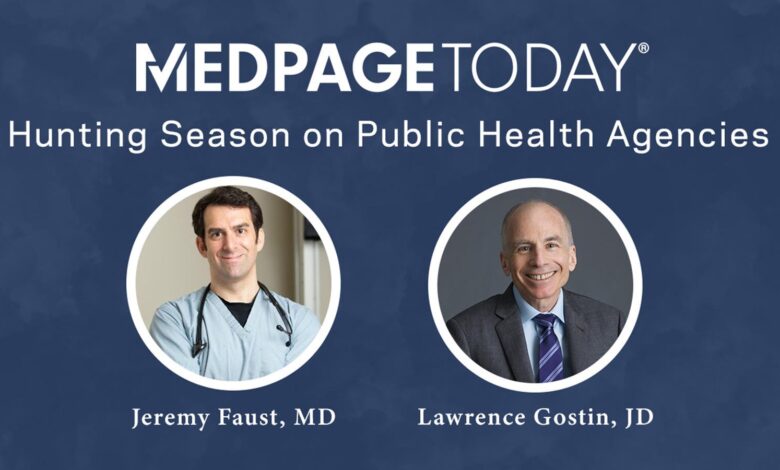
In this Instagram Live clip, MedPage Today editor-in-chief Jeremy Faust, MD, and Lawrence Gostin, JD, director of the O’Neill Institute at Georgetown University in Washington, discuss how the Supreme Court has limited the powers of public health agencies.
The following is a transcript of their remarks:
Faust: Let’s talk about expertise though, because you said something before as well that led to a good segue back to some of the topics I want to get to, which is this idea that — Who do you want to believe? Who do you trust more, a court or the CDC or public health?
And now, sadly, there’s been enough misinformation and undermining of these agencies that some people actually think the judges are better. I would question that, and not just because I disagree with some of the judgements, but just in their discussion of the facts.
Gostin: They get the medicine and the science wrong all the time.
Faust: Yeah. And this idea of what’s an expert, there’s a whole body of law on that. There was this case, Loper Bright Enterprises v. Raimondo, which came out this year. Can you explain to our viewers what they need to know about that case and how it applies to healthcare?
Gostin: Basically, Loper Bright was an environmental law case and it asked the question, ‘Should judges defer to the rulings of the EPA [Environmental Protection Agency] when the statute by Congress is ambiguous?’ That is, who should make the decision? Should it be EPA scientists or should it be the court?
Well, for 50 years since a Supreme Court decision called Chevron [v. National Resources Defense Council], we’ve always said that agencies have dealt with these environmental and other public health and safety problems for a long time, they’ve got experience, they’ve got expertise, and we should let them make the decision. Judges should defer to them. And Chevron is one of these super precedents; it’s been upheld not just once but it’s been cited in some 15,000 cases.
So this is something that the court just simply said ‘No, now all of those judges were wrong. All of that precedent was wrong. From now on, we the judges are going to make that decision, not the agency.’ It has enormous implications, certainly for environmental law, for environmental health, air pollution, water pollution, plastics, you name it — but also, it affects every agency.
Many agencies — in fact I would say most agencies — are charged with protecting the public’s health, safety, or the environment. These are really dangerous decisions. It doesn’t get the same national press attention as we see with abortion, but in many ways its reach and its consequences for the health and safety of the United States and the American people is even much deeper and greater.
It’s very troubling, but it’s not just Loper Bright and Chevron. The court has really had four or five major what I call ‘gut punches’ to the administrative state. It’s a whole range. I won’t get into all the technicalities, but basically it’s open hunting season against health safety and environmental rules. And career agency scientists are always going to be looking over their shoulders, always defending lawsuits.
That really troubles me a lot because of precedent, because of the expertise and reliance we have on agencies to keep us healthy and safe, and because they are acting in accordance with a charge from Congress — they’re not acting unilaterally. All of these have authorizing statutes from Congress saying, ‘Go ahead, protect occupational health and safety, protect the environment, protect against infectious diseases, approve safe and effective drugs,’ and on and on and on. All of that is at risk.
Faust: I mean, every single one of these agencies you listed, and we could add more sub-agencies — the Center for Medicare & Medicaid Services being the one that we call out the most — have these executive rules, right? Essentially, these regulations that have gone through this very baroque process of rule adaptation and in many cases the implementation that has taken years or decades.
Does Loper Bright Enterprises mean that all those rules are actually now vulnerable to suit? Or is the perspective like, okay, going forward on a new rule, they’re going to do something different?
Gostin: What a brilliant question.
So I have to return to another case that the Supreme Court decided the same term as Loper Bright. And that case basically says that there was a statute of limitations where people could sue against agency rules. What they ended up doing is suing for only a period of time that the statute allowed, about 5 years since the rule was in place, and then you couldn’t sue anymore. What the Supreme Court did is it said that the 5-year time period doesn’t begin until the person is actually injured or actually adversely treated.
So what does that mean? It means that it’s forever litigation. Because when a big company is trying to challenge a 20-year-old rule, they’ll just form a new entity, a new shadow company or a shell company, and they sue. Or they find a new plaintiff who happened to just get a claim of being harmed by it.
So in other words, all of these old rules that we thought were in the rear view mirror and they’re safe — nothing is safe anymore. That’s the second gut punch.
Faust: The reason I was surprised by this, and again I’m not a legal scholar but I read a little bit about it, was just on the logistics of this. Like oh my gosh, if they’re going to allow this — and we’ll talk about the abortion pill cases — to me the thought was if they’re going to do this, what they’re really doing is inviting a tidal wave of law that will just tie up the courts for years. There’s just not enough. There aren’t enough judges and lawyers in the world to litigate all this.
So is it just going to grind the system to a halt? And is that the point?
Gostin: You know, it probably won’t grind the system to a halt.
You’ve got a lot of judges mostly appointed by Trump that are known to be hostile to say abortion rights or administrative agencies and things like that. And these plaintiffs shop for their favorite judge, knowing what the judge will do, they go there, they sue, and in some cases, a lot of these judges then issue nationwide injunctions, which is what happened in the abortion cases and also what happened in the Mifepristone case.
It’s crazy. And the Supreme Court is just simply allowing all this. I grew up a great admirer of the Supreme Court, this was the Warren Court. Justice Brennan wrote a forward to my book.
I just had this reverence for the court. I don’t anymore.