Carzon Wentz played an important part in the Eagles’ Super Bowl win over the Chiefs

The Philadelphia Eagles are Super Bowl champions for the second time in franchise history. That’s not the topic of this post, however it is ALWAYS worth mentioning that fact again. The Birds were led to their second title on Sunday by Super Bowl MVP Jalen Hurts, but he might not have been the MOST valuable quarterback on the Superdome field for Philadelphia.
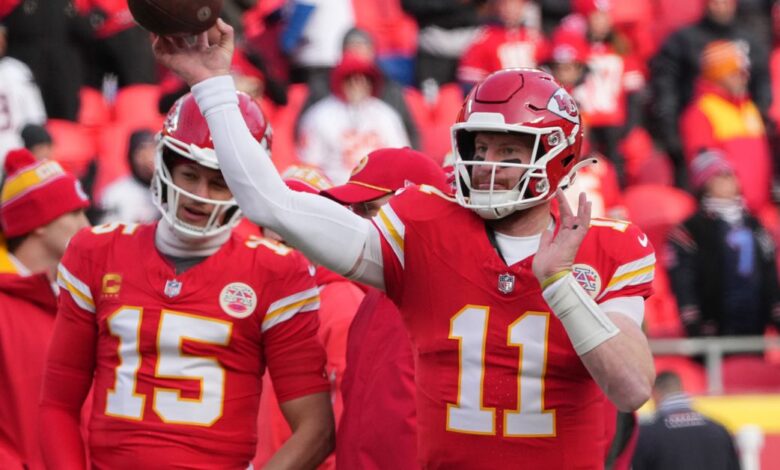
That honor, arguably, could go to Kansas City Chiefs backup QB, and former first round pick and franchise savior of the Eagles, Carson Wentz. NFL news robot Adam Schefter posted a handy graphic before the game on Sunday showing all of the players that Eagles GM Howie Roseman ended up acquiring due to trading Wentz to the Indianapolis Colts.
Chiefs backup QB Carson Wentz has an indirect role in helping to assemble the roster that will try to prevent Kansas City from three repeating today. The Eagles traded Wentz to the Colts for a 2021 3rd-round pick and conditional 2022 1st-round pick.
The Eagles then used that… pic.twitter.com/P1zGYJOND4
— Adam Schefter (@AdamSchefter) February 9, 2025
After being benched in the twelfth game of the 2020 season, Wentz was shipped to the Colts after the season so that the Birds could see what they had with a young Jalen Hurts. Hurts had completed the 2020 season, in which the Eagles finished 4-11-1, as QB1 and it was clear that Philadelphia intended to move forward with him and not Wentz.
Roseman, who is smarter than just about every other NFL executive in the league, was able to secure two draft picks for Wentz: a 2021 third round draft pick (84th overall) and a conditional 2022 pick that became a first round pick (16th overall) based on Wentz’s playing 75% of the Colts’ snaps in 2021. It should be noted that the Eagles took a significant cap hit in this trade, so there was a lot riding on these picks turning into contributors. Well, dear reader, let’s just say that Roseman’s gamble paid off even more than the most optimistic fan could’ve predicted.
Let’s take a journey through transactions past, friends!
First up: the Eagles used the 2021 third round pick from the Colts and their own first round pick (12th overall) to trade up to pick No. 10 and select Devonta Smith, the Heisman Trophy winning wide receiver out of Alabama.
Second up: entering the 2022 NFL Draft, the Eagles had three (!!!) first round picks. Their own pick (19th), the second round pick from the Colts that turned into a first round pick (16th) because of how much Wentz played, and Miami’s first rounder (15th) that was acquired in a separate trade from before the 2021 draft.
Roseman did a monster deal with the New Orleans Saints where he received:
- 2022 first rounder (18th overall)
- 2022 third rounder (101st overall)
- 2022 seventh rounder (237th overall)
- 2023 first rounder
- 2024 second rounder
He sent this back to the Big Easy:
- 2022 first rounder (16th overall; former Colts pick)
- 2022 first rounder (19th overall; Eagles pick)
- 2022 sixth rounder (194th overall)
With the Eagles coming up on the clock in the 2022 first round, Roseman made ANOTHER deal and traded the 18th overall pick and the 101st overall pick to the Tennessee Titans for stud wide receiver A.J. Brown. You may remember Brown from such exploits as “having a 106-catch season in 2023,” “scoring 11 touchdowns in 2022,” and “reading a book on the sidelines in 2024 to help preserve his mental health.”
Thirdly: in the 2023 draft, the Saints first round pick that Roseman acquired the year earlier ended up being the 10th overall selection. He then traded that pick (and a 2024 fourth round pick) to the Chicago Bears to move up one spot in the first round in order to select offensive line collapser Jalen Carter out of Georgia. The defensive tackle slid in the draft due to his involvement in a car crash that ended up killing his UGA teammate Devin Willock and team staffer Chandler LeCroy.
Carter finished as the runner up for the AP Defensive Rookie of the Year in 2023 and made the Pro Bowl and was AP second team All-Pro in 2024 while also, you know, winning the Super Bowl.
Lastly: the 2024 second round pick that the Eagles got from the Saints back in 2022 ended up being the 50th pick in the 2024 draft. Roseman packaged that pick, No. 53 overall, and No. 161 overall to the Washington Commanders for pick No. 40, pick No. 78, and pick No. 152.
Those picks ended up becoming:
- No. 40: CB Cooper DeJean (Iowa)
- No. 94: OLB Jalyx Hunt (Houston Christian); the Birds traded down twice in the third round from Washington’s pick No. 78
- No. 127: RB Will Shipley (Clemson); part of one of the trade downs mentioned above
- No. 152: WR Ainias Smith (Texas A&M)
Hunt recorded two tackles and 0.5 sacks in the Super Bowl and DeJean had three tackles, a pass defended, and I feel like I’m forgetting something he did on Sunday. Eh, I’m sure it’ll come to me later.
Shipley forced a fumble and rushed for 77 yards and a touchdown on four carries in the NFC Championship victory over Washington.
So, there you have it. Carson Wentz (and Howie Roseman, duh) contributed a TON to the Eagles Super Bowl run this season despite having not worn a Birds jersey since 2021. In fact, Wentz has been on the sidelines for BOTH of Philadelphia’s Super Bowl wins. He must be some sort of good luck charm, huh?