The following is a press release from MX Sports
The second day of action at the 2024 Monster Energy AMA Amateur National Motocross Championship Presented by AMSOIL saw the completion of the first set of motos for all 36 classes of competition in addition to the beginning of the second motos for select divisions. Highly competitive, unpredictable racing defined Wednesday’s competition and set the stage for the heightened levels of intensity that will emerge as the week rolls on.
The most dynamic class at the Ranch, Open Pro Sport features a unique mix of elite prospects and vastly experienced veterans, which combines for a one-of-a-kind battle for the coveted AMA National Championship. Case in point, defending champion Cole Martinez spent nearly a decade in the pro ranks and is accompanied by the likes of Andrew Short, Heath Harrison, and Jacob Hayes this summer.
Despite the wealth of experience on the gate, it was youth that grabbed the spotlight during Wednesday’s opening moto. Specifically, Monster Energy Kawasaki Team Green’s Drew Adams. After an incredible 34th to fourth climb in 250 Pro Sport on Tuesday, Adams enjoyed a much less dramatic outing in the Open division. The Tennessee native positioned himself in a prime spot off the start in third and showed patience in a methodical march to the front. Adams was consistently the fastest rider on the track and put an exclamation point on his pass for the lead with the fastest lap of the entire moto. He continued to pull away over the second half of the moto and took the checkered flag 16.2 seconds ahead of the field.
Following Adams across the line was fellow Monster Energy Kawasaki Team Green rider Enzo Temmerman to complete a 1-2 for the decorated OEM effort. The California rider began the moto in second but quickly moved into the top spot on Lap 2 and brought Adams along with him. From there it became a showdown between the Team Green racers, with Temmerman pacing the first half of the moto before ultimately settling into the runner-up position.
The podium was rounded out by NSA Factory Yamaha Team rider Leum Oehlhof, who emerged with the STACYC Holeshot and paced the field on the opening lap. He ran third for most of the moto, but did drop outside the top three for several laps after he lost the spot to his NSA Factory Yamaha Team teammate Avery Long. However, Long encountered late misfortune, which allowed Oehlhof to reclaim the spot the rest of the way. KTM rider Noah Stevens followed in fourth, with KTM Orange Brigade’s Jeremy Fappani in fifth.
Moto 2 for Open Pro Sport is scheduled for Thursday.
- Drew Adams, Chattanooga, Tenn., Kawasaki
- Enzo Temmerman, Visalia, Calif., Kawasaki
- Leum Oehlhof, Oak Hills, Calif., Yamaha
- Noah Stevens, Danbury, N.C., KTM
- Jeremy Fappani, Scottsdale, Ariz., KTM
Another class brimming with prospects, Schoolboy 2 also garnered a lot of attention on Wednesday with a talented lineup of B class racers. In the end, it became a showcase of dominance for Monster Energy Kawasaki Team Green’s Caden Dudney, who parlayed the STACYC Holeshot into an impressive wire-to-wire performance that saw the Texan make a major statement. Dudley established a multi-second lead of more than three seconds on the opening lap and continued to add to that advantage, cruising to the finish line 12.9 seconds clear of the field.
The Team Green squad secured another 1-2 effort thanks to a strong closing stretch from Landen Gordon, who took the 250 B win on Tuesday. A fifth-place start forced the California native to engage in a slew of battles early on and it took several laps for him to generate some forward momentum. However, once he got rolling, he became the fastest rider on the track over the second half of the moto and made a last lap pass to snag the runner-up finish.
Third place went to EBR Performance Altus Yamaha’s Landon Hartz, who took advantage of a strong start to pursue Dudney in second for nearly the entirety of the moto. The Alabama native was very consistent throughout the moto, except for one lap at the halfway point of the moto. That one slow lap caused Hartz to lose valuable ground to Gordon and ultimately saw the Yamaha rider settle for third. Fourth place went to Rock River Yamaha’s Logan Best, while Rockstar Energy Husqvarna Amateur Elite racer Landon Gibson rounded out the top five.
Moto 2 for Schoolboy 2 (12-17) B/C is scheduled for Friday.
- Caden Dudney, Athens, Texas, Kawasaki
- Landen Gordon, Murrieta, Calif., Kawasaki
- Landon Hartz, Wilsonville, Ala., Yamaha
- Logan Best, North Port, Fla., Yamaha
- Landon Gibson, Peachtree City, Ga., Husqvarna
The Supermini class is the highest and most competitive level of the minibike division as up-and-coming racers begin to harness their talents and showcase the capabilities of these small motorcycles. Whenever the gate drops on a Supermini moto, it’s a must watch.
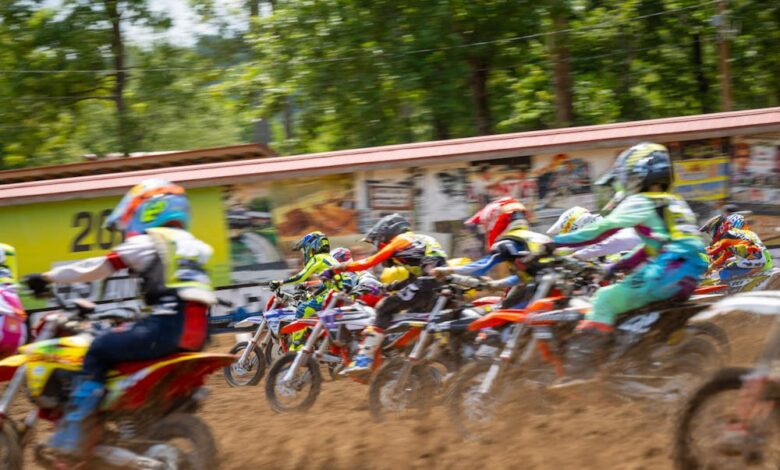
The opening moto didn’t disappoint in showing the competitiveness of the division as the final results saw the top four finish within four seconds of one another. The race began with the Monster Energy Kawasaki Team Green ride of Carson Wood out front with the STACYC Holeshot. Right behind him was Darren Pine and the new GASGAS MOB effort, followed by KTM rider Grant McDonald and GASGAS rider Dannyn Reed.
Wood faced heavy pressure from Pine in the early laps but maintained his hold of the lead. However, Pine’s persistence paid off as Wood crashed out of the lead just before the halfway point and remounted in fourth. With first place in his grasp, Pine laid down consistent lap times and successfully managed a small margin over McDonald, while Reed lurked in third, ready to make a move if the opportunity presented itself.
The gap between the leaders dipped under a second in the closing laps, but Pine didn’t falter and secured a tight moto win by just 1.2 seconds over McDonald, with Reed right behind them in third. Wood gained ground late to follow in fourth, while KTM rider Aidan Zing rounded out the top five.
The action was similarly exciting in the opening Supermini 2 moto, which began with the KTM of Jace Baker secure the STACYC Holeshot, only to be passed initially by McDonald, who was then passed by second generation racer Vincent Wey aboard his Team Husqvarna Amateur Racing machine. The opening laps soon saw a captivating battle between Wey and Reed, who moved up to second, followed closely by KTM rider Brody Barth and McDonald. As Wey looked to inch away, both Barth and McDonald made the move around Reed.
While Wey continued to lead, the other three members of the lead foursome continued to trade positions. That battle allowed Zingg to become the fifth player in the fight, with the California rider overcoming a drop down to 10th in the running order early on. As the race surpassed the halfway point the top three started to tighten up with Wey facing heavy pressure from both McDonald and Zingg, who were the two fastest riders on the track.
With just a few laps remaining Zingg laid down the fastest lap of the moto to vault from third to first on the same lap and set sail through the finish, leaving both McDonald, who moved up to second, and Wey behind him. Zingg stormed to the moto win by 3.9 seconds over McDonald, while Wey lost pace late to finish third. Fourth place went to Barth, while Wood battled back from a 25th-place start to make an incredible charge to fifth.
- Darren Pine, Montgomery, Texas, GASGAS
- Grant McDonald, Cairo, Ga., KTM
- Dannyn Reed, Payson Utah, GASGAS
- Carson Wood, Zephyrhills, Fla., Kawasaki
- Aidan Zingg, Hemet, Calif., KTM
- Aidan Zingg, Hemet, Calif., KTM
- Grant McDonald, Cairo, Ga., KTM
- Vincent Wey, Murrieta, Calif., Husqvarna
- Brody Barth, Seymour, Wis., KTM
- Carson Wood, Zephyrhills, Fla., Kawasaki
As the wave of second motos got underway over the second half of Wednesday’s action it provided an opportunity to see the budding superstars of 250 Pro Sport return to the track. A dominant performance by Monster Energy Yamaha Star Racing’s Cole Davies gave the New Zealander all the momentum for the second gate drop, but he ended up not factoring into the battle for victory.
As the moto got underway, NSA Factory Yamaha Team rider Avery Long was at the head of the pack with the STACYC Holeshot. Long was able to maintain his hold of the lead early on, but a hard-charging Drew Adams, fresh off his Open Pro Sport triumph, had his sights set on tracking down the Yamaha. However, Adam went down and lost several positions, eventually remounting in sixth.
Back up front, Long enjoyed a comfortable margin over his NSA Factory Yamaha Team teammate Leum Oehlhof but gave it up with a crash in the Ten Commandments. That allowed Oehlhof to take over the lead as Adams remounted in second. As the moto entered the late stages it looked as though it was going to be a head-to-head battle between the Yamaha duo. However, they made contact with one another and both fell to the ground. That opened the door for Adams, who had clawed his way back up to third, to seize control of the moto.
Once out front with a clear track, Adams set sail and easily distanced himself from the field. The Tennessee native went on to wrap up a sweep of his two Wednesday motos, taking the checkered flag 3.5 seconds ahead of SLR Honda’s Parker Ross, who kept it on two wheels to capture a quiet runner-up finish. Long rebounded to finish third, with Oehlhof fourth. Monster Energy Kawasaki Team Green’s Enzo Temmerman was fifth.
The Moto 2 victory vaulted Adams to the top of the 250 Pro Sport overall standings, tied with Long.
The third and championship deciding third moto for 250 Pro Sport is scheduled for Friday.
- Drew Adams, Chattanooga, Tenn., Kawasaki
- Parker Ross, Herald, Calif., Honda
- Avery Long, New London, Minn., Yamaha
- Leum Oehlhof, Oak Hills, Calif., Yamaha
- Enzo Temmerman, Visalia, Calif., Kawasaki
After an exciting first moto saw Andrew Short prevail with the win aboard his KTM, all eyes were on the potential rivalry between Short and Munn Racing KTM’s Mike Brown as the Senior class returned to the track for Moto 2.
A fall while leading the first moto proved to be a difference maker for Brown, who entered Wednesday determined to get back on top the podium. As the gate dropped to open the second moto it was indeed Brown who seized the moment to charge to the STACYC Holeshot and sprint away from Short and the rest of the field on the opening lap. Brown proceeded to establish a torrid pace through the first half of the moto, which allowed him to eventually build a lead of more than four seconds over Short, who kept Brown honest for several laps.
As the moto wore on, Brown’s consistency allowed him to move further and further away from the field. His lead soon grew to double digits as wrapped up a convincing wire-to-wire performance to steal the momentum from Short, who finished nearly 13 seconds back in the runner-up spot. Finishing third was defending champion Jeff Emig, who once again was forced to battle his way forward from a start outside the top five. While the podium result is an improvement for Emig, he’s yet to have a chance at mixing things up with Brown and Short at the head of the pack. Honda rider Shane Kelleher finished fourth, while fellow Honda rider James McNeill rounded out the top five.
With one moto win and a second-place finish for each, Brown and Short sit tied atop the overall standings after two motos. It will all come down to the third and final Senior (40+) moto scheduled for Friday.
- Mike Brown, Bristol, Tenn., KTM
- Andrew Short, Smithville, Texas, KTM
- Jeff Emig, Riverside, Calif., Husqvarna
- Shane Kelleher, Cumberland, R.I., Honda
- James McNeill, Washingtonville, N.Y., Honda
Click for Moto 2 Results
Click for Overall Standings
2024 AMA Amateur National Motocross Championship Wednesday Winners
65cc (7-9): Beckham Smith, Canyon, Texas, KTM
250 C Jr. (12-17) Unlimited: Kaiden Vargas, Newcastle, CA, Honda
450 B Limited:
85cc (10-12) Limited: Nolan Ford, Fairfield, Calif., KTM
Schoolboy 1 (12-17) B/C: Owen Covell, Plymouth, Mass., Yamaha
Senior (45+): Shane Kelleher, Cumberland, R.I., Honda
250 C Limited:
WMX: Kyleigh Stallings, Yukon, Okla., Kawasaki
65cc (10-11): Jaydin Smart, Berry Creek, Calif., Cobra
Vet (30+): Brando Haas, Chesterfield, Calif., Yamaha
450 B: Diesel Thomas, Raymond, Neb., Husqvarna
125 C:
85cc (10-12): Braxtyn Mes, Temecula, Calif., Husqvarna
65cc (7-9) Limited: Maverick Gresham-Lewis, Yuba City, Calif., GASGAS
Mini Sr. 2 (13-15): Dane Pappas, Livermore, Calif., GASGAS
450 C: Jason Norwood, Howell, Mich., Husqvarna
Day 3 action from the Monster Energy AMA Amateur National Motocross Championship can be seen exclusively on RacerTV.