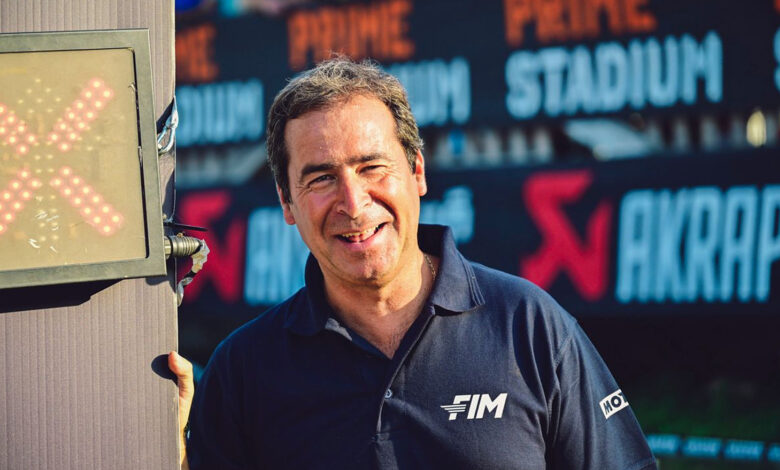
Instrumental in the safe and smooth running of the Paulo Duarte FIM EnduroGP World Championship, FIM Race Director Pedro Mariano is strongly involved with organising each round of the championship.
From racers to team managers, organisers and promoter, Pedro has been a familiar face to all within the Paulo Duarte FIM EnduroGP World Championship paddock for over 15 years now. Constantly liaising with everyone, it’s his responsibility to deliver safe racing at the high standard of an FIM World Championship.
Born and raised in Portugal, where he calls Lisbon home, the former forest engineer and professional basketball player has been deeply rooted in enduro for over three decades now. From rider to sports official, both within the Portuguese Motorcycling Federation (FMP) and the International Motorcycling Federation (FIM), we took five minutes with Pedro to learn more about his role in EnduroGP, and how as a teenager he had to hide his enduro bike from his mother…

Pedro, tell us how your connection to enduro began, we hear it’s somewhat unconventional!
Pedro Mariano: “I started riding at 17. My mother, trying to avoid buying me a Casal Boss, which was everyone’s dream back then, or a DT50, gave me a Moto 4 instead! It cost four times as much but had four wheels and, according to her, was safer. So I used that to go to school and for other activities. My first real motorcycle came thanks to the Lousã Enduro event. I bought it in Leiria, but kept it hidden at my uncle’s house in Lousã so my parents wouldn’t find out. I used to ride it on weekends whenever I was there!”
When did the bug for racing take hold?
“In 1990. At the time, I was a professional basketball player in the first division, but motorbikes, especially enduro, always fascinated me. A close friend from Lousã lent me a bike for the first enduro event held there. I decided to take the challenge and entered the race. I didn’t win, but I did set the best time on all the special tests. However, I arrived four minutes early at the final checkpoint and was penalised. I ended up almost last in my class. In total, I raced enduro for nine years before moving to rally raid and finishing up in Moto 4.”
How did you transition from rider to federation official at FMP and then FIM?
“Unfortunately, I had to stop racing in 2000 due to health issues. I was hospitalised for two years and it was a complicated period. The current FIM President already knew me from my participation in the national enduro team, where I raced in three 6DAYS® FIM Enduro of Nations (ISDE). When a new board took over the FMP, I was invited by Eng. António Pocinho to lead the Enduro Commission in 2001. Later, when Jorge Viegas returned to the presidency, he invited me to Lisbon to serve as his Secretary General. I held both roles simultaneously.”

And your journey at the FIM?
“I started at the FIM around 2002/2003, joining the Environmental Commission, where I remained for two years. During that time, I helped create the first environmental training materials and the first environmental exam, along with two British colleagues. I always had a strong interest in the Enduro Commission, but FIM’s internal rules only allowed one representative per national federation per commission. Once that changed, I immediately moved to the Enduro Commission, where I still serve today.”
When did you begin serving as the FIM Race Director?
“In 2009, when Portugal hosted the 6DAYS® FIM Enduro of Nations (ISDE), a new Commission Director introduced the idea of having permanent FIM representatives at each event. That’s how the roles of Race Director and Track Inspector were created. I’ve been the Race Director ever since, going on 15 years now. The Track Inspector has changed twice, with Maurizio Micheluz currently in charge. Our roles are crucial, not just in representing the FIM and the riders, but in supporting local organisers.”
What tasks and jobs are involved in the role of FIM Race Director?
“Work starts months before the event, analysing the supplementary regulations. We address any concerns with the organisers and follow up with on-site inspections, led by Maurizio. While he focuses on the course and special tests, my responsibility is to ensure that the regulations and FIM standards are fully applied and to manage all administrative and operational aspects during the event. Close coordination with the Clerk of the Course is essential. That’s why I insist on having them with me throughout the race, especially when fast decisions are needed during crises, such as weather-related disruptions, penalties or schedule changes. These decisions must be made quickly, and once made, they have to be followed through. They’re not always perfect, but the priority is always safety and fairness.”

How has enduro evolved in terms of environmental responsibility?
“Enduro has always been one of the more environmentally conscious disciplines. Since the 1990s, we’ve used eco-friendly tyres, conducted sound checks and introduced environmental mats to catch any fluids. These are crucial since most events take place in forested areas. The FIM also launched the KISS program (Keep It Shiny and Sustainable) to promote sustainability in motorsport. If we want respect and visibility, we must act responsibly and reach those outside the sport, especially urban audiences who often criticise motorcycles. Last year, every single round of the FIM Enduro World Championship included a KISS event. I believe no other discipline has matched that. Tree planting initiatives at race venues, for example, have had a lasting impact—we’ve returned years later to see the trees we planted thriving.”
Finally, what can you tell us about the upcoming GP of Portugal in September that replaces the GP of France?
“The GP of Portugal in Vila de Rei is being prepared with real commitment. Fortunately, we had a club with national experience eager to return to organising. After two site visits, I believe the necessary conditions are in place to successfully replace the cancelled race. Despite the short time frame, limited budget (given the small size of the local council) and high wildfire risk, the organising team is doing an extraordinary job. We’re even preparing a contingency plan: if needed, we’ll adapt the race into a sprint enduro with urban-based special tests. This could end up being one of the surprise highlights of the season.”
The Paulo Duarte FIM EnduroGP World Championship continues with the Forsiteservices GP of Wales in Rhayader for round four on August 1-3.
2025 Information
Don’t miss your chance to represent FIM EnduroGP in style this season. Explore the 2025 shop today at shop.endurogp.com.
The Paulo Duarte FIM EnduroGP World Championship community is growing fast on our socials. Be sure to follow us on Instagram, Facebook and YouTube to stay updated with all of the action.
2025 Paulo Duarte FIM EnduroGP World Championship
Round 1: GP of Portugal – Fafe – 4-6 April
Round 2: GP of Spain – Oliana – 2-4 May
Round 3: GP of Sweden – Skövde – 23-25 May
Round 4: GP of Wales – Rhayader – 1-3 August
Round 5: GP of Portugal – Vila de Rei – 12-14 September
Round 6: GP of Italy – Darfo Boario Terme – 26-28 September
Round 7: GP of Germany – Zschopau – 17-19 October
2025 Expotrade FIM Women’s Enduro World Championship
Round 1: GP of Portugal – Fafe – 4-6 April
Round 2: GP of Wales – Rhayader – 1-3 August
Round 3: GP of Portugal – Vila de Rei – 12-14 September
Round 4: GP of Germany – Zschopau – 17-19 October