What to know off every NFL Week 17 game: Bengals keep hope alive in overtime thriller

-

NFL Nation, ESPNDec 28, 2024, 09:54 PM ET
A critical Week 17 began with a pair of games on Christmas Day, as the Kansas City Chiefs took down the Pittsburgh Steelers and the Baltimore Ravens won at the Houston Texans to alter the complexion of the AFC North race. On Thursday, the Seattle Seahawks moved road teams to 3-0 on the week by taking down the Chicago Bears, keeping Seattle in play for the NFC West title and a playoff berth.
Saturday’s tripleheader kicked off with the Los Angeles Chargers punching their playoff ticket with an easy win over the New England Patriots, then continued when the Cincinnati Bengals picked up an overtime victory over the Denver Broncos to stay alive in the AFC playoff race.
Our NFL Nation reporters reacted to all the action, answering lingering questions coming out of each game and detailing everything else you need to know for every team. Let’s get to it.
Jump to:
KC-PIT | BAL-HOU | SEA-CHI
LAC-NE | DEN-CIN

Cincinnati 30, Denver 24 (OT)

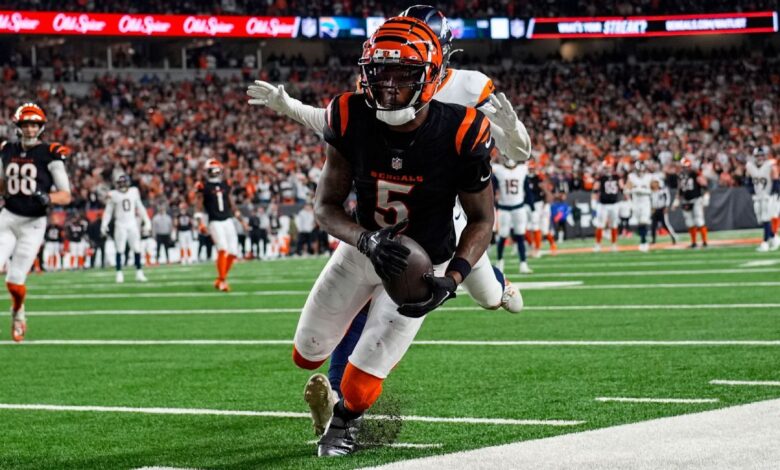
Did Tee Higgins play his last game in Cincinnati? Perhaps. With his contract up after this season, Higgins is set to be a free agent. And after the game, he acknowledged that Saturday could have been his final game at Paycor Stadium, with no home games on the docket regardless of whether the Bengals make the playoffs or not. But after catching 11 passes for 131 yards and three touchdowns, Higgins showed why his services will be coveted around the league in 2025.
Describe the game in two words: Absolute chaos. Cincinnati blew two chances to win the game late but didn’t squander the third to keep its playoff chances alive heading into Week 18.
Most surprising performance: Cincinnati’s defense, which has been scrutinized all season, had a massive performance. Even after Cincinnati blew a potential game-winning field goal attempt in overtime, the Bengals got a three-and-out, giving the offense enough time to go back down the field for Higgins’ third and final touchdown of the night. — Ben Baby
Next game: at Steelers (Jan. 5, TBD)

Broncos
Can the Broncos bounce back and win a make-or-break game for a playoff spot? Going into the Week 16 contest with the Chargers, the Broncos had three games to get the one win they needed to make the playoffs. After losses to the Chargers and Saturday against the Bengals, Denver must win the regular-season finale against the Chiefs to get the 10th victory they need to clinch a postseason spot. The Broncos were a downcast group after Saturday’s loss, aware of how much breathing room they’ve let slip away. The Chiefs might rest players after clinching the AFC’s No. 1 seed Christmas Day, but the Broncos must beat their nemesis to end an eight-year playoff drought.
Early prediction for next week: The Chiefs will test cornerback Riley Moss. Such is life for the guy opposite of Pat Surtain II, and Moss was mostly up to the challenge before suffering a knee injury last month. But Moss found himself squarely in the sights of Joe Burrow over and over in his first game back. Moss had struggles against Bengals receiver Tee Higgins and must prepare to be the focus of the Chiefs’ passing attack next week.
What we learned about the QB today: Bo Nix has discovered how thoroughly opposing defenses can adjust to a quarterback in-season. He has found it increasingly difficult to get to throws in the middle of the field and didn’t have a completion longer than 16 yards Saturday until his 51-yard touchdown throw to Marvin Mims Jr. with 8:48 to play. But Nix did overcome an interception late in the fourth quarter to throw a game-tying touchdown pass to Mims, one of three he threw Saturday. — Jeff Legwold
Next game: vs. Chiefs (Jan. 5, TBD)
L.A. Chargers 40, New England 7

Chargers
Can the Chargers make a deep playoff run? Saturday’s win reflected a team equipped to win playoff games. The Chargers’ combination of rushing and Justin Herbert‘s passing prowess made for a blowout win against a bad Patriots team. The challenge for the Chargers is re-creating that formula against winning opponents. The Chargers can still secure a higher playoff seed with a win over the Raiders and a Steelers loss next week. In that scenario, the Chargers would have a first-round matchup against the Houston Texans, who have lost three of their past five games.
Most surprising performance: Derwin James Jr. had two sacks Saturday, which brought him to a career-high 5.5 this season. After one of James’ worst seasons in 2023, Chargers defensive coordinator Jesse Minter has James playing like one of the league’s best again. Saturday’s game was one of his most dominant performances of 2024.
What we learned about the QB on Saturday: Without pressure, it is nearly impossible to stop Herbert. The Patriots pressured him on only six of his 40 dropbacks (15%), the fifth-lowest pressure rate of his career. When Herbert was not pressured, he made the Patriots pay, finishing 23-for-32 with 257 yards and three touchdowns. — Kris Rhim
Next game: at Raiders (Jan. 5, TBD)

Patriots
What does the loss say about first-year head coach Jerod Mayo and the direction of the franchise? Nothing good. The 3-13 Patriots played the AFC East champion Bills tough last week, so their hope was to build on it and provide some level of optimism heading into the offseason. Instead, they were dominated from the outset — in their home stadium, which was maybe a bit more than half full. When a team endures a season like this, there are often significant changes as a result. Owner Robert Kraft has some important decisions to make about Mayo, the coaching staff and vice president of player personnel Eliot Wolf and his staff.
Describe the game in two words: No charge. The Patriots ran 15 offensive plays in the first half, tied for the fewest by any team in a first half in the past five seasons — a reflection of how they were outclassed from the start.
Eye-popping stat: With his 36-yard touchdown strike to receiver DeMario Douglas, Drake Maye now has three touchdown passes this season of at least 35 air yards, the most such touchdown passes by a Patriots quarterback since Tom Brady had three in 2009. — Mike Reiss
Next game: vs. Bills (Jan. 5, TBD)
Seattle 6, Chicago 3

Seahawks
Can the Seahawks beat the Rams and make the playoffs? The Seahawks didn’t necessarily have to beat the Bears to keep their playoff hopes alive, but they will have to win next week in Los Angeles to have any shot at claiming the NFC West, and their dud of an offensive performance Thursday night doesn’t inspire much confidence they will. Granted, the circumstances weren’t ideal, with a long flight and a holiday condensing an already short week. Rainy conditions didn’t help either. But Geno Smith & Co. will have to be much better next week if they want to beat the Rams — and they probably need Los Angeles to lose Saturday to Arizona for that Week 18 game to matter in the first place.
Describe the game in two words: Dominant defense. The Seahawks went to work against the most sacked quarterback in the NFL, with six different players combining to drop Caleb Williams seven times. Leonard Williams and Devon Witherspoon each had three tackles for loss in addition to a sack, and Riq Woolen — who was benched for the opening drive last week after an unspecified violation of team rules — sealed the win by intercepting Williams’ desperation heave.
Early prediction for next week: Offensive coordinator Ryan Grubb will have a better plan for pushing the ball downfield. Smith’s 3.1 air yards per attempt were his fewest of the season by half a yard and less than half of his 7.0 average from the first 15 games. Chicago took away Seattle’s deep passing game, forcing Smith into shorter throws that required his receivers to rack up yards after the catch. — Brady Henderson
Next game: at Rams (Jan. 4 or 5, TBD)

Bears
What sparked Chicago’s worst offensive performance of the season? Caleb Williams and the Bears offense was, in a word, awful. Williams averaged 1.3 air yards per completion, which was his lowest mark of the season, and completed only one pass for 10 or more yards downfield. This performance looked as bad as Chicago’s last 3-point output against the Patriots and featured seven drives that ended in punts. There were so many frustrating moments, from another scoreless first quarter to Chicago’s clock management on the final drive when it had a chance to get into field goal range to send the game to overtime.
Describe the game in two words: Hard watch. Chicago’s defense put its best foot forward in holding the Seahawks to six points, but the Bears’ offense failed to wake up and match that effort. The Bears tacked on their 10th straight loss, which is tied for the longest streak in a season (2022) in franchise history.
Biggest hole in the game plan: The left side of the offensive line was decimated by injuries to Braxton Jones and Teven Jenkins, who did not play against Seattle. Williams is at fault for holding onto the ball too long in moments, but the porous pass protection against the Seahawks’ blitz stood no chance. Williams was sacked seven times, bringing his season total to 67. — Courtney Cronin
Next game: at Packers (Jan. 4 or 5, TBD)
Baltimore 31, Houston 2

Ravens
What does this Ravens’ win mean for the AFC North? The Ravens are now one win away from repeating as AFC North champions. Baltimore holds a one-game lead over the Steelers, who lost to the Chiefs on Wednesday. The Ravens end the regular season at home against the last-place Cleveland Browns next week. With Lamar Jackson putting together another NFL MVP-caliber season and a defense that has dominated recently, the Ravens not only look like the team to beat in the division but appear as if they will be a major force in the AFC playoffs.
Describe the game in two words: Total domination. Jackson and Derrick Henry combined for 234 yards rushing, and the Ravens’ defense would have recorded its first shutout since 2018 if not for Henry being tackled in the end zone for a safety. Baltimore outgained Houston 432-210, which was the Ravens’ second-largest margin in total yards over the past four seasons. The two points allowed are the fewest by any team on Christmas since Tennessee beat Dallas 31-0 in 2000.
Eye-popping stat: Jackson reached a maximum speed of 21.25 mph on his 48-yard touchdown run in the third quarter. According to Next Gen Stats, that’s the highest top speed of Jackson’s seven-year career. It is the second-fastest max speed by a quarterback this season, ranking only behind Arizona’s Kyler Murray (21.27 mph). — Jamison Hensley
Next game: vs. Browns (Jan. 4 or 5, TBD)

Texans
Can this Houston team win in the playoffs? Because the Texans won the AFC South, they’ll host a playoff game. But right now Houston doesn’t look primed to make a playoff run. Against winning teams, the Texans are 1-5, and losing to the Ravens in the fashion they did gives little indication they can compete with the best of the best.
Most surprising performance: The defensive line. The Texans sacked quarterback Lamar Jackson only once and allowed the Ravens to rush for 251 yards. Defensive ends and stalwarts Danielle Hunter and Will Anderson Jr. combined for 0.5 sacks.
Early prediction for next week: Texans starters play only a quarter against the Tennessee Titans. Houston is locked into the No. 4 seed, so there’s little incentive for them to play starters for long in Week 18. Risking important players getting hurt isn’t worth it, especially when safety Jimmie Ward, nickel Jalen Pitre, and receivers Stefon Diggs and Tank Dell are already out for the season. — DJ Bien-Aime
Next game: at Titans (Jan. 4 or 5, TBD)
Kansas City 29, Pittsburgh 10

Chiefs
As the AFC’s top seed, should the Chiefs sit key players next week? Definitely. That’s particularly true for players with injuries, like Patrick Mahomes and Chris Jones. The Chiefs should expand the list of resting players as much as possible to include Xavier Worthy and others. These players will have an extended break because the Chiefs will also get a first-round playoff bye, but coach Andy Reid will need to find a way to keep them sharp.
What we learned about the QB on Wednesday: It has been a long wait but Mahomes can still complete the long ball. Mahomes’ 49-yard pass to Justin Watson in the first quarter traveled 40 yards in the air, making it his second longest such pass of the season. His TD to Worthy in Week 4 against the Chargers went 54 yards in the air.
Most surprising performance: Mike Danna took advantage of expanded playing time in the absence of Jones to have a big pass-rushing game. Danna, who entered with 1.5 sacks this season, had two more against Russell Wilson. The Chiefs sacked Wilson five times. — Adam Teicher
Next game: at Broncos (Jan. 4 or 5, TBD)

Steelers
Are the Steelers capable of making noise in the postseason? Despite three consecutive losses, the Steelers are still postseason-bound. But the struggles that have plagued this team during this stretch have all but erased any possibility of them being a contender. The once-stout defense isn’t creating the takeaways or getting off the field, and Russell Wilson is playing more like the Wilson that struggled in his first season in Denver than the one who won five of his first six starts in Pittsburgh.
Describe the game in two words: Revealing loss. With a boost from the return of several key players, the Steelers had a chance to right the ship — or at least start turning it around — against a tough team playing without its best defender in Chris Jones. Instead, they took on more water in a blowout loss and don’t appear to be a team capable of making noise in the playoffs.
What we learned about the QB on Wednesday: The clock might be close to striking midnight. Wilson held on to the ball too long at times, contributing to a season-high five sacks. He also had his second red zone turnover in as many weeks, this time on an interception in the end zone. But despite his miscues, Wilson still showed flashes of brilliance — it was just too inconsistent to make up the difference. — Brooke Pryor
Next game: vs. Bengals (Jan. 4 or 5, TBD)