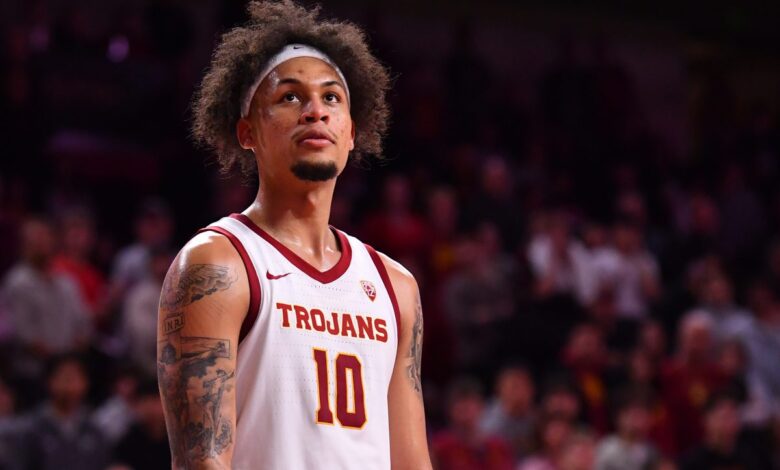
Why Rodman’s son believes he’s NBA ready after Warriors workout originally appeared on NBC Sports Bay Area
DJ Rodman knows what comes with his name. The son of NBA Hall of Famer Dennis Rodman was part of a six-player Warriors pre-draft workout Thursday and turned back the clock to when he first began playing basketball.
Not as a tiny tyke shooting with dad, but watching him on TV as a 10-year-old – more than a decade after Rodman last played in the NBA.
“People don’t know that he wasn’t really in my life that much,” Rodman said to reporters at Chase Center and media members on Zoom. “It’s cool, I remember when I was little I used to watch Hardwood Classics on NBA TV.
“It’s cool just looking back at those memories when I was little and watching those clips and having that be something that I studied almost every single day. Almost every single day they’d play one of those games. Rebounding, that’s where I got it from – from those videos, from those games.”
Dennis arguably is the greatest rebounder in NBA history at 6-foot-7. DJ, 6-foot-6, averaged 4.2 rebounds in his five-year college career. They’re two different people, and two different players. Dennis made 82 3-pointers in his 14-year NBA career. DJ made 89 threes his final two years in college.
Rodman spent his first four college seasons at Washington State and ended at USC. He started only 12 games his first three years, averaging 3.9 points and 3.3 rebounds while shooting 32.7 percent from deep. But in his final two years Rodman started 58 of 63 games and averaged 29.5 minutes, 9.0 points, 5.4 rebounds and made 37.2 percent of his threes. He mostly played as an undersized four because of his toughness and improvements as a rebounder.
Offensively, Rodman became a strong spot-up shooter. Now, he’s hoping to show teams he’s more assertive on offense. Rodman has told every team he’s worked out with that he’s become “significantly better” there and wants to showcase his skills more as a wing.
But to do that, Rodman and his representative Tyrell Jamerson of Triple Double Sports came to the agreement he needed to make changes to his shot. Don’t let the last name fool you. Rodman was self-taught growing up. He didn’t have personal trainers, his game wasn’t being perfected.
“I like to watch myself, because now I actually jump on my jump shot,” Rodman said. “I actually look like a basketball player when I shoot the ball.”
Rodman earlier joked he jumped “maybe 2 inches” when he shot at USC. He compared his past shooting mechanics to Chantel Osahor, who shot 37.2 percent from three as a senior at Washington, even though her feet stayed stuck to the court.
Despite their differences as players, the innate shared traits of father and son were unmistakable as Rodman spoke about his game. He talked about rebounding as a science, not an athletic feat. Rodman expressed his desire to guard the other team’s top scorer and prided himself on being able to guard one through five in college, being a nuisance and finding ways to get in his opponent’s head.
The dog? It’s in there.
“It’s in my blood, ironically,” Rodman recognizes. “It’s true. It’s in my blood. But other than that, I feel like it’s something I can control on a night to night basis. You can’t control if you’re going to make shots. You can control your effort level on the defensive end.
“You can control giving your team the best opportunity to win by stopping your matchup or stopping one of the best players on the opposing team.”
Steph Curry. Klay Thompson. Andrew Wiggins. And many more in the past.
The Warriors have a long history of success with players who have ties to bloodlines in the NBA. Rodman might be next.
“It went great, kind of kicked my butt a little bit,” Rodman said of his Warriors workout. “Just running a lot. I had a good time, though. You need someone to kick you in the butt and wake you up a little. It was great, I had a fun time.”
Rodman didn’t take a one-year path like his fellow USC teammate with a more famous name. DJ’s road, like his father’s, was a longer one to reach the NBA. For reasons far from his namesake, Rodman believes his path and continued development has him set for success with the Warriors or any other team at the next level.