Dale Fairbanks Blends His Jazz Background with a Passion for Crafting Vintage-Inspired Guitars

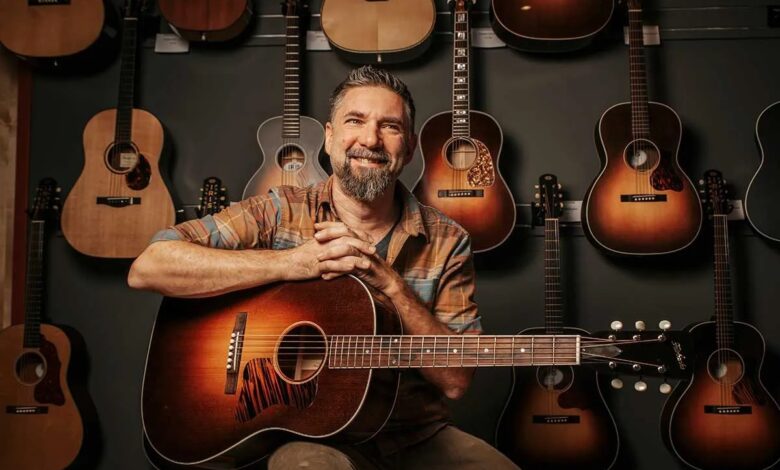
Sometimes you walk into a guitar shop, and one instrument stands out. Maybe it’s the look, or maybe a staff member hands it to you with a nod and says, “Try this.” That happened to me this summer in Lawrence, Kansas, at the renowned Mass Street Music. Among the Martins, Collings, and vintage pieces hanging on the walls, a Fairbanks F-20 caught my eye. Modeled after a vintage Gibson L-00, the F-20 had an aged black finish and fire-stripe pickguard that were impossible to ignore. Once I played it, the guitar’s rich, resonant sound took over as I ran through everything from fiddle tunes to originals to a Thelonious Monk blues. I was completely hooked.
Dale Fairbanks, the luthier who built the guitar, has steadily gained prominence over the past few years, building a reputation for crafting vintage-inspired instruments that capture the essence of classic American steel-strings while improving on their design for modern players. Originally from Connecticut, Fairbanks relocated to Burlington, Vermont, in 2019 to join forces with Adam Buchwald, the builder and entrepreneur behind Circle Strings and Iris Guitars and owner of Allied Lutherie. Fairbanks Guitars, now operating out of the shared workshop, has become a key player in this thriving community of luthiers.
I recently caught up with Fairbanks over Zoom, and we talked about his journey from being a jazz trumpeter and guitarist with coffee-shop day jobs to becoming a master luthier. Among other things, he reflected on his early days making guitars by hand on an enclosed porch, the challenges of refining his craft, and accommodating some interesting requests for custom builds.
Your experience in music started with playing trumpet at age nine, which carried you through studies at Berklee. With that background, how did you come to guitar making?
I went through a period where I listened to trumpet and the history of jazz, starting with Louis Armstrong. Throughout my teens, I went through the decades and eventually listened to some Miles Davis in the ’80s, which is pretty good stuff. When I was 15, I took a left turn when my girlfriend taught me guitar, fingerpicking stuff, and we went to see a house concert in Providence with Paul Geremia. I was transfixed, sitting on the floor of this living room. Around the same time, I was sitting on my parents’ couch with piles of note cards, each with a single picking pattern, and that’s how I learned.
What style were you doing?
I did thumb and two fingers—Travis picking. I learned some North Carolina stuff, like Elizabeth Cotten, and Geremia took it in a much looser direction that I really liked. Instead of sticking to strict patterns, he’d throw in everything else. Because of him, I had a really hard attack. I was also heavily influenced by Tom Rush’s first album, Blues, Songs, and Ballads, and Reverend Gary Davis—I listened to Harlem Street Singer on repeat throughout college.
How did you go from learning guitar to making one?
I was doing gigs here and there, playing both guitar and trumpet—for example, if I caught a Connecticut salsa band passing through I would play with them. It didn’t get me anywhere quickly, and I was working at Starbucks and playing a lot at night on my couch. I was really into 12-string baritone guitars, Lead Belly, and Charlie Patton. Around that time, Del Arte in California released their Lead Belly 12-string. It was the first new guitar I’d seen in that style, but I couldn’t afford it. So, I bought William Cumpiano’s book [Guitarmaking: Tradition and Technology], and I read it cover to cover more than a dozen times over the course of a year.
Around ’98, at a fretted instrument workshop in Amherst [Massachusetts] I acquired a mid-1930s Gibson L-00, which furthered my interest in old guitars. That’s when I got the idea that I should build one. I was living in Brighton with a long-term girlfriend, and we had a second-floor apartment with one of those enclosed porches they call a piazza. It was a six-by-12-foot space, and I hauled a drill press and a bandsaw up there. I had my shooting plane for the tops and backs. I took a big hand plane, removed the blade, filed notches into it, and reassembled it so I could thin plates of rosewood by hand. I don’t know why I thought that was a good idea—it took a really long time. My goal was to make a baritone 12-string. I didn’t finish much before we broke up, and I moved to my parents’ house in Connecticut around 2000. That’s when I took over their basement.
Now that I’m saying all this out loud, I realize I was kind of a late bloomer when it came to adulthood. I was still working at Starbucks, but I cut down to 20 hours so I could spend more time making guitars. It took me a long time to build that first 12-string because I really wanted to get it right, and I had a lot of false starts. I was kind of a perfectionist; I wanted fancy checkered herringbone purfling that no one made back then. So, I had a binding and purfling company in Washington state [Gurian Instruments] make me a bunch of strips. I think I finally finished the guitar sometime after the 2000 GAL [Guild of American Luthiers] convention. I still have the headstock I cut off, and it’s hanging in the bathroom at my current shop.
Take us from that first instrument to the launch of Fairbanks Guitars.
I made about ten or 15 guitars, plus a bunch of false starts and rejected plates. I was trying to get something that I thought would probably sell, rather than just making something for my own satisfaction. And early on, I met Dakota Dave Hull. He’s a ragtime fingerstyle guitarist based in the St. Paul/Minneapolis area. He’s still going strong. I think he’s in his early 70s now, and he has six or seven guitars of mine, but the very first one I sold—number 15—went to him. He still tours with it.

Dave goes overseas a lot and got me in contact with a Japanese dealer there early on. He lived down the road from Hoffman Guitars in Minneapolis and got me in touch with those people; he’s just been a big help all around. That gave me the confidence to take an instrument up to the Music Emporium. I brought a slope-shoulder dreadnought to show them, an advanced jumbo style. One of the owners seemed lukewarm, but later his co-owner called me and said, “I think we really like it. You should bring it back up and we’ll sell it.”
How did things evolve from there?
At a certain point, my wife and I were living in West Hartford, Connecticut, in a Cape [Cod house] with a detached garage in the back. It took about three years to convert this garage I had into a shop. I nailed up the garage doors permanently, put drywall and some spray foam insulation in there, and got the electricity upgraded. I got a spray booth in there and built a cupola, got the spray booth exhaust going up through the cupola. So, you know, incognito in the middle of a neighborhood. It was a sweet shop. I was cruising along there, and I really liked it.

At what point did you connect with Adam Buchwald?
I was in the shop from around 2015 to 2019—that is, after 15 years of commuting to my parents’ basement. Throughout that time, I would go to festivals and guitar shows, and I met Adam Buchwald a few times, and we always had a good time talking shop. Around 2016, he was upgrading his thickness sander, so I bought his old one from him. I rented a van and drove up there and met him for the first time in his previous shop on Home Avenue, and I think he was working alone at that point. Then, in the summer of 2019, he called me and said, “I have this opportunity to buy Allied Lutherie. What should I do?” I said, “Look, if you want to take on that responsibility and move that company from California to Vermont, and you have that sort of energy, then please go right ahead. I would love to have you up there supplying me wood.” And that’s what he did.
Soon after that conversation, he called me again and said, “Would you like to come join me?” That was when he had the idea of creating Iris Guitars. He wanted me to come up and help develop the line and bring everything together with him. I talked to my wife. She didn’t hesitate. She said, “Do it.” She grew up in central Connecticut and was tired of it. Vermont sounded great, even though we both love warm weather.
What was it like to go from working on your own to working with Buchwald?
In 2008, when I started the business, I owned my own company. I told Adam I didn’t want to punch a clock again, so we agreed to own the business 50/50, and went to a CPA and signed all the papers and everything. That worked for a year or two, but as the company grew, Adam did less building and more wheeling and dealing. Eventually, we made the decision for all the companies—Allied Lutherie, Fairbanks, Circle Strings, and Iris—to come under one umbrella, with Adam being the owner. I gave up my share, trusting him to handle it.
At first, Adam and I had different visions. I would have kept a small team, while Adam wanted to grow. So I said, “You can do that; I’ll just build guitars.” My role has changed over time. Initially, I couldn’t build my own line because we didn’t have enough skilled people, so I helped design Iris guitars. As we grew and hired and trained more skilled workers together, I stepped back from Iris production to focus on my own line. We’re still working to integrate my guitar line into the established Iris production style and schedule.
How does your building style fit into the business?
I’ve kept my own style of building, which is different from Adam’s. That’s a good thing, since we want separate lines with different price points. The Iris guitars were developed with my influence, and my guitars have evolved a little due to Iris’ influence, but they’re not the same. My line is still primarily built by me, though the finishing and setup are handled by a team. The one thing I have kept, though, is I still do all my own bursts. And the CNC machines have been a huge help, saving my shoulders.
Have you sought to improve on the designs or construction of the vintage instruments that inspired your line of guitars?
The bottom line is that the guitars that inspired the ones I make were factory instruments. They were not bespoke or custom, but rather just churned out to make a profit for these companies. The ones that survive are really good because they had experienced people working there, but they were still factory guitars. With mine, I try to reproduce the old guitars but make them better, with more common sense. For example, I use dovetail joints and double-action truss rods. I also pay attention to things like top thickness and brace stiffness, which large factories didn’t.
I try to stay true to old building methods where they work well, like using dovetail joints, but I’m not interested in reproducing things that never made sense in the first place. For example, some old Gibson guitars had weird top arches that caused problems. It was this flat rim and arched back, and they had to press down the back, kind of smoosh it down to get it glued. That resulted in these dimples at the waist, like you see along with cracks on some old Gibsons. I made a couple of guitars like that for a dealer, but it wasn’t practical for long-term durability, so I don’t recreate those mistakes.
How much of your work is stock versus custom?
Most of my work—about 60 to 75 percent—is custom. Dealers order straightforward guitars that sell well, but private clients often ask for unique builds. I’ve worked on some interesting custom projects, like one guitar that incorporated Vermont flora and fauna in the inlays. The client wanted to bring a cool rock from a piece of granite that he found from his property, but my CNC guy said, “No, we can’t inlay rock. It won’t cut.”
Another I made in tribute to a client’s love of weed and jam bands, and also in memory of his father. It had wagon wheel and red cardinal inlays in the headstock as well—you can see it on my website [under the blog section]. I had all this stuff that was able to work with the CNC guy, and that was a good two-year process. The custom builds certainly have elements that are very different from the ones that you see at the dealers. Though I like building for dealers because it’s straightforward—they never ask for anything crazy and just want what will sell—it’s so much fun to build private orders and bring clients’ visions to life.